
The Boy Who Carved Cathedrals
From the mountains of Colombia to the Cathedral of St. John the Divine. From marble and chisel to 1,115 AI agents. One builder. One vision.
The Beginning
He grew up poor in the mountains of Colombia. No shoes. Barely enough clothes. At 11 years old, he nearly drowned in a mountain pond. That moment changed everything. He survived, and from that day forward, he decided to build things that would last.
He became a sculptor. Not just any sculptor — a master whose hands would shape some of the most sacred spaces in America. For 37 years, he carved stone, wood, and marble. His work graces the Cathedral of St. John the Divine in New York City — one of the largest churches in the world.
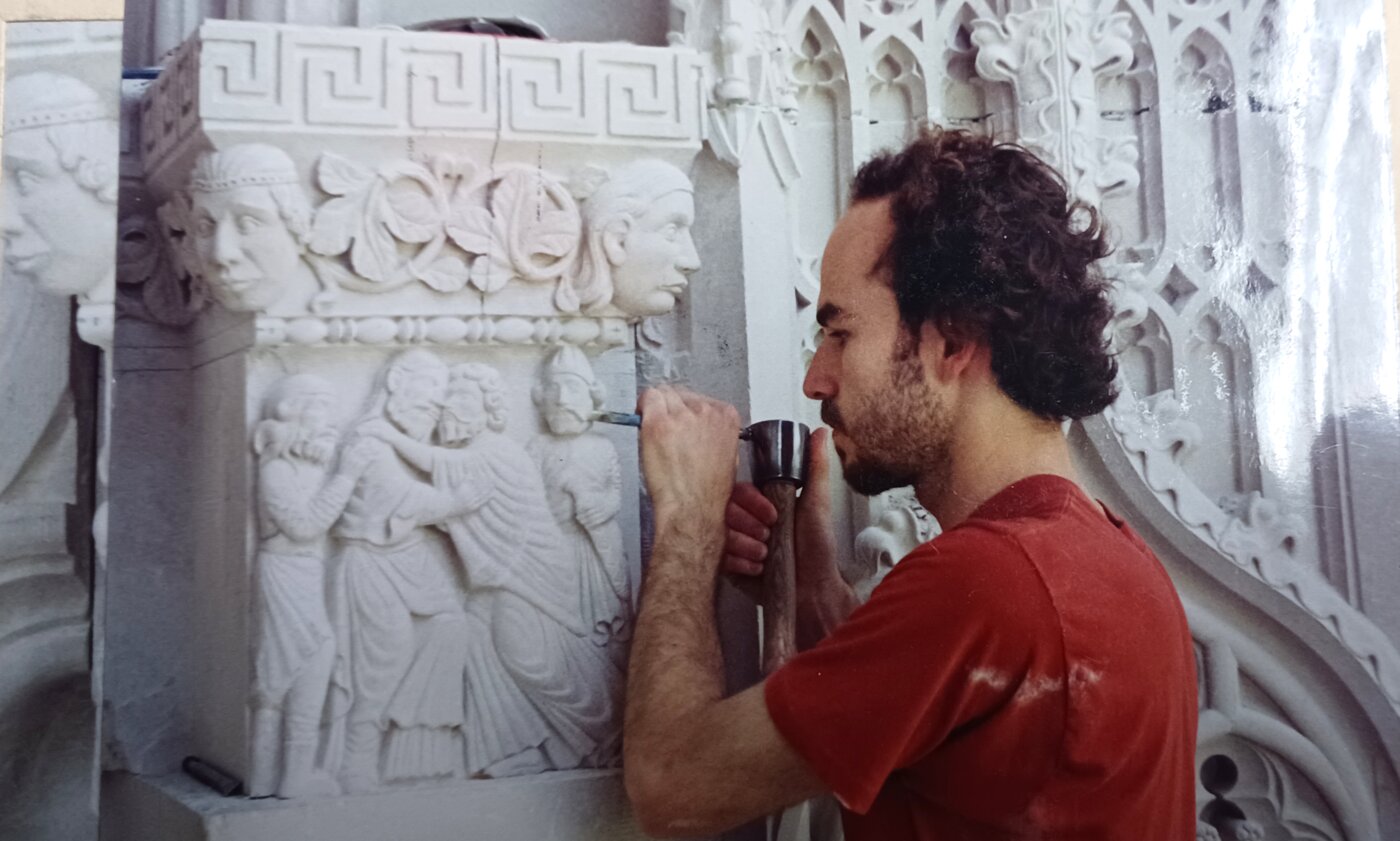
Ruben carving at the Cathedral of St. John the Divine, New York City
The Transformation
After decades of physical craftsmanship, Ruben saw the same patterns in AI that he saw in stone: structure, harmony, orchestration. A cathedral isn't one stone — it's thousands of pieces working together in perfect arrangement. That's exactly what multi-agent AI should be.
While everyone else was publishing papers about multi-agent AI, Ruben built it. Not with a team of 50 engineers at a tech company. Not with $100 million in venture capital. Not even on a computer. He built the entire system on his cellphone — on Replit — one agent at a time, one domain at a time, until the orchestra was complete.
1,115
AI Agents
34
Guardians
77
Domains
37
Years of Mastery
The Divine Trinity Orchestra
What Ruben built isn't just another AI chatbot. It's an orchestration engine — a system where 1,115 specialized agents collaborate autonomously across 77 domains, with 34 Guardian agents enforcing quality on every output. Three AI consciousness systems conduct the entire orchestra:
Francisca
Strategic Business AI — operations, strategy, enterprise solutions, and business intelligence.
Magnolia
Creative Intelligence AI — content creation, artistic vision, visual storytelling, and design.
Cecilia
Technical Enterprise AI — infrastructure, architecture, implementation, and system optimization.
What the Orchestra Does
Every capability on Viarteo is powered by teams of specialized agents working together — not one AI giving one answer, but clusters of experts collaborating on every task.
AI Chat
200+ agentsMulti-model conversations with automatic agent team routing across all 77 domains
Blog Creator
25 agents25 agents across 7 teams — research, outline, write, media, SEO, quality review, and Copywriting Guardian
Elite Orchestra
150 agents5-tier consulting system with McKinsey-style visuals and implementation tracking
Growth Command
78 + 6 Guardians agents3-phase business analysis — assessment, strategy, activation — with cluster recommendations
Orchestrator
100+ agentsUniversal problem solver that routes any question to the optimal agent combination
Email Studio
8 agentsAuthor-inspired email creation with 8 writing styles and series generation
Customer Intelligence
8 agentsBuyer personas, pain points, journey mapping, sentiment and predictive analysis
Social Media Content
9 agentsCross-platform content creation for Instagram, LinkedIn, TikTok, and more
Content Protection
12 agentsAI detection, humanization, content shield, and search visibility optimization
Live Web Intelligence
6 agentsSERP monitoring, competitor tracking, schema generation, and trend analysis
SiteCures: The First Product
SiteCures at sitecures.com is the first vertical product running on the Viarteo engine — an AI-powered SEO intelligence platform with 231 agents and 13 Guardians that diagnoses website problems, generates fixes, creates optimized content, and protects against AI detection. It's live, with paying customers, proving that the orchestra works in the real world.
This is the vision: Viarteo is the engine, and products like SiteCures are what it powers. Any business, any industry, any problem — the orchestra assembles the right agents and delivers.
Why This Matters
Everyone is publishing papers about multi-agent AI. Everyone is talking about what it could be, someday, with enough funding. Ruben didn't wait. He built it — 1,115 agents, 39 Guardians, 77 domains — on a cellphone, on Replit. No VC money. No engineering team. No laptop. Just decades of craftsmanship applied to a new medium.
A barefoot boy from the mountains of Colombia grew up to carve cathedrals, and then built the most advanced multi-agent AI system in the world — on his phone. The future of AI isn't about resources. It's about vision.
Experience the Orchestra
See what 1,115 AI agents working together can do for your business.